Understanding How Long Invisalign Takes
How Long Does Invisalign Take?
| From | To | |
|---|---|---|
| A little (minor fixes) | 3 months | 6 months |
| A medium amount | 6 months | 18 months |
| A lot (complex issues) | 18 months | 24+ months |
What Makes Some Cases Take Longer?
Different dental problems need different types of tooth movement. Some movements are simple. Some are tricky. Below, we explain each one and what it means for your treatment time.
Invisalign to fix Gaps Between Teeth (Spacing)
Usually takes: 6 – 18 months
A gap between your teeth happens when there’s extra space in your mouth. It might be one gap or several.
Invisalign slowly moves your teeth together to close those gaps.
- Small gap (under 2mm): 6 – 9 months
- Medium gap (2–4mm): 9 – 15 months
- Multiple or larger gaps: 15 – 18+ months
Why can’t gaps just close quickly? If teeth move too fast, it can damage the roots or make the bite uneven. So your dentist moves them slowly and carefully.
One thing worth knowing, gaps often come with a deep bite too, which adds some extra steps to treatment.
At Bayview Dental, we use a special 3D scanner called the iTero to map out your gaps and give you an accurate timeline at your very first visit.
Invisalign to fix Crooked or Overlapping Teeth (Crowding)
Usually takes: 6 – 24 months
Crowding is the most common reason people get Invisalign in Australia. It’s when your teeth don’t have enough room, so they push against each other, overlap, or twist.
- Mild crowding: 6 – 12 months
- Medium crowding: 12 – 18 months
- Severe crowding: 18 – 24+ months
Why does crowding take so long sometimes? Twisted teeth are hard to move. In fact, a tooth can only rotate about 1 to 2 degrees per aligner.
Sometimes, teeth need a little bit of filing between them (called IPR) to create space. In serious cases, a tooth may need to be removed first (more on that below).
Quick fact: Twisted back teeth (like premolars and canines) are the hardest to straighten with aligners and often need special grips called attachments glued to your teeth.
Invisalign to fix a Deep Bite
Usually takes: 12 – 24 months
A deep bite is when your top front teeth cover your bottom front teeth too much when you bite down. In bad cases, your bottom teeth can’t even be seen.
This is one of the trickier problems for Invisalign to fix. Here’s why your dentist needs to:
- Push your front teeth slightly up into the gum
- Lift your back teeth a little to open the bite
- Do all of this without hurting your jaw joint
- Mild deep bite: 12 – 18 months
- Moderate to severe: 18 – 24+ months
Your aligners may have special built-in ramps called bite ramps to help hold your jaw in the right position during treatment.
If your deep bite has worn down your teeth over time, you may need some dental repair work done after Invisalign is finished. Your Bayview Dental dentist will talk you through this.
Invisalign to fix an Open bite
Usually takes: 12 – 20 months
An open bite is when your back teeth touch but your front teeth have a gap between them, even when your mouth is closed. This can make it hard to bite food, speak clearly, or feel confident smiling.
Open bites happen for two main reasons:
- Habits like thumb sucking or the tongue pushing against teeth
- Jaw shape that developed differently during growth
Invisalign works best for habit-related open bites. Jaw-related open bites may need extra treatment or even surgery.
- Mild open bite: 12 – 15 months
- Moderate open bite: 15 – 20 months
- Severe open bite: May need jaw surgery alongside Invisalign
Important: Open bite cases are especially sensitive to not wearing aligners enough. If you skip hours, your teeth can slide back. This is one case where sticking to 22 hours a day is a must.
Invisalign to fix a Crossbite
Usually takes: 12 – 24 months
Normally, your upper teeth sit slightly outside your lower teeth. A crossbite is when some upper teeth sit on the inside — meaning they cross over the wrong way.
This can happen at the front of your mouth, the back, or both sides.
- Back teeth crossbite: 12 – 18 months
- Front teeth crossbite: 6 – 18 months
- Both sides crossbite: 18 – 24 months
Crossbites need special attachments on your teeth so the aligners can push them in the right direction.
Why fix it early? If a crossbite is left alone, it can cause your jaw to grow unevenly, wear down your teeth, and cause jaw pain. The earlier it’s treated, the simpler the fix.
Expanding the back teeth with aligners tends to tip the teeth outward rather than move the whole root. That’s why getting a proper diagnosis early really matters.
Invisalign to fix a Tilted Smile (Dental Cant)
Usually takes: 12 – 24+ months
A dental cant is when your smile line isn’t level, one side sits higher than the other. You might notice it in photos or when you smile. It can make your smile look off-balance even if your teeth are otherwise straight.
Cants can come from:
- The teeth themselves being at different heights
- The jaw bones growing at different levels
Invisalign can fix tooth-level cants by moving teeth up on one side and down on the other. But jaw-level cants usually need surgery, with Invisalign used before or after.
- Minor cant: 12 – 18 months
- Significant cant: 18 – 24+ months
- Jaw-level cant: Surgery + Invisalign combined
Dental cants are easy to miss in a standard check-up. At Bayview Dental, our 3D digital scanning picks up even small asymmetries that the naked eye might not catch. These cases often work best when Invisalign is combined with other treatments.
Other Things That Affect Your Timeline
Even with the same dental problem, two people can have different treatment times. Here’s what else plays a role:
Wearing your Invisalign enough
This is the biggest one. Less than 20–22 hours a day means slower results, sometimes months slower.
Refinements
Most people need at least one extra set of aligners made during treatment to fine-tune the results. This is completely normal and adds roughly 2 to 6 months.
Keeping your attachments intact
Those small tooth-coloured dots glued to your teeth help the aligners do their job. If one falls off, get it fixed quickly. Delays add up.
Your age
Younger jaws are softer and respond faster. Adults take slightly longer because bone is denser.
Showing up to appointments
Regular check-ins every 6 to 8 weeks let your dentist catch any issues early. Skipping them can mean problems go unnoticed and add time later.

What Happens When You're Done?
Great news, the hard work is over. But here’s the thing: you’ll need to wear a retainer forever (at night) to keep your teeth in place. Without one, teeth slowly drift back.
At Bayview Dental, we offer:
Vivera retainers
Removable, made by Invisalign, clear and comfortable
Fixed retainers
A thin wire bonded behind your teeth, completely hidden
Both combined
For more complex cases
Invisalign FAQs
How long does Invisalign take for mild crowding?
Usually 6 to 12 months if you wear your aligners consistently every day.
Is Invisalign faster than braces?
For mild to moderate cases, they're often similar. Invisalign can sometimes be quicker. For very complex cases, times are usually about the same.
What happens if I don't wear my aligners enough?
Your teeth won't move as planned. This is the most common reason treatments run over time, sometimes by several months.
How often do I need to visit Bayview Dental?
Usually every 6 to 8 weeks, though complex cases may need more frequent visits.
Does Invisalign take longer for adults than teenagers?
Yes, slightly. Adult bone is denser so teeth move a little more slowly than teenagers. But the difference is usually not dramatic.
Can I speed up my Invisalign treatment?
The biggest factor in treatment speed is compliance. Wearing your aligners 20 to 22 hours every day is the single most effective thing you can do. Switching to new aligners on the prescribed schedule, attending your check-ins, and responding promptly to remote monitoring requests all keep treatment on track. Some patients also use AcceleDent or similar vibration devices, though the clinical evidence on these is mixed. Ask Dr Chandra at your consultation whether any acceleration approach is appropriate for your case.
Ready to Find Out Your Timeline?
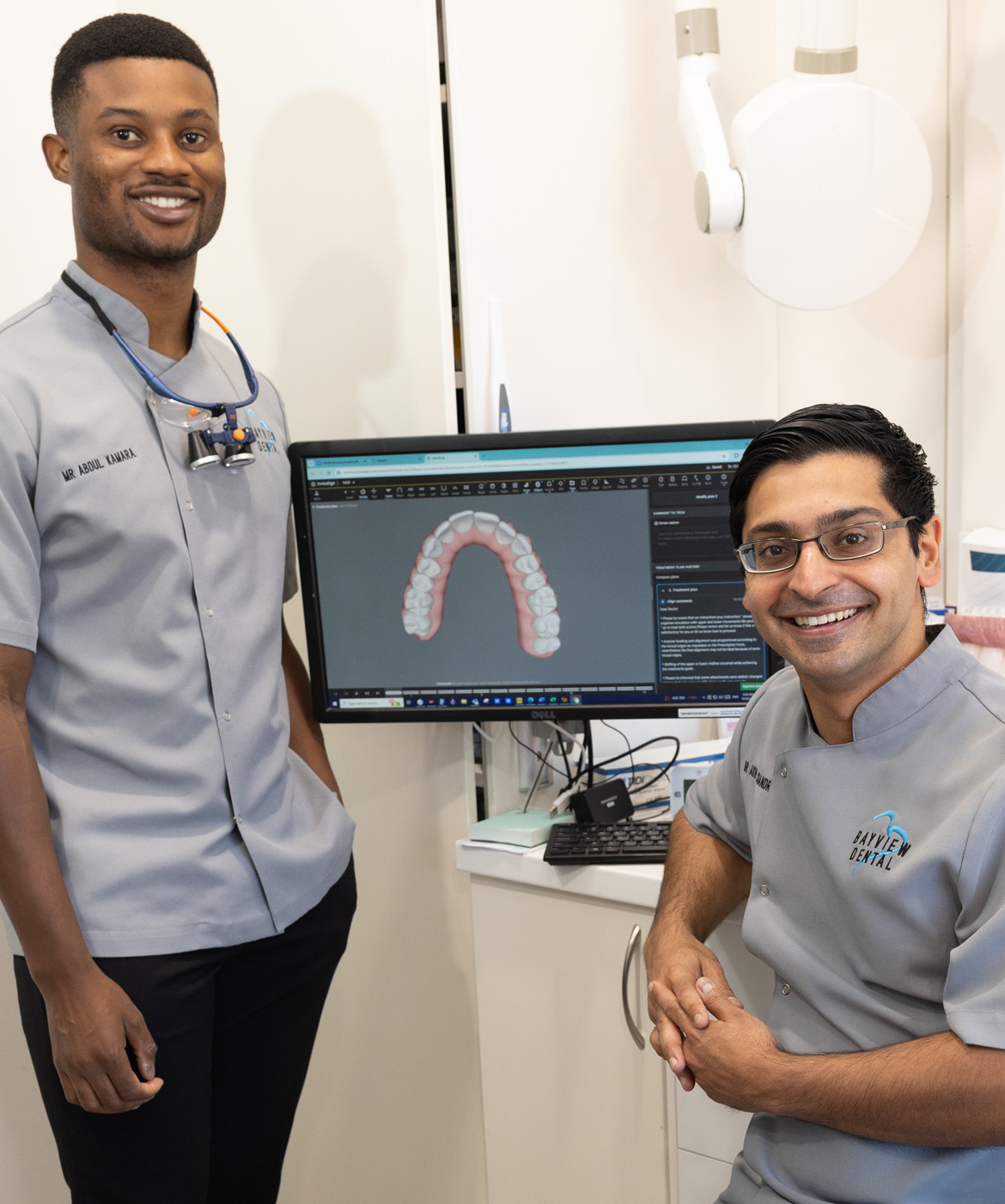
The only way to know for certain is a proper assessment and 3D scan. At Bayview Dental Claremont we use the iTero® digital scanner to map your teeth in full 3D. No impressions, no mess.
From there we build your ClinCheck® simulation, showing you exactly how your teeth will move and giving you a realistic timeline before you commit to a thing


 .
.

